Losing a bid on price is part of the business. Losing one because of something you could have controlled hurts more. When general contractors level subcontractor bids, the same avoidable mistakes push good subs to second place again and again.
Here are five of the most common, and how to fix each one before your next bid goes out.
1. Vague or missing exclusions
A bid that says "per plans and specs" and little else forces the GC to guess what you included. Most GCs will assume the worst and add money to your number to cover anything that might be missing.
Spell out what you include and what you don't, and reference specific spec sections where you can. A clear scope is easier to level, and it protects you if something is disputed later.
2. Missing addenda
Addenda often change quantities, details or specified products days before the bid. If your bid doesn't acknowledge every addendum, the GC either has to call you or assume your price is based on outdated documents. On a public job, a missing acknowledgment can make your bid non-responsive.
Track addenda as they come in, update your takeoff, and list every addendum number on your bid.
3. Padding instead of pricing risk
When drawings are unclear, it's tempting to add a percentage across the whole bid. The problem is that every other sub is pricing the clear parts of the job without padding, so a blanket contingency makes you look expensive on the work everyone understands.
Price what's clear, then call out the unclear items separately: an allowance, a clarification or an RFI response you're waiting on. You stay competitive on the base scope while still protecting yourself.
4. Arriving late, or at the last minute
Bids that arrive minutes before the deadline get less attention. The GC is assembling dozens of numbers and has no time to call you with questions. Bids that arrive a little earlier get reviewed properly, and if something is unclear, you get a call instead of a deduction.
Build your schedule backwards from the bid date and aim to submit at least a few hours early. If you can't finish a full takeoff in time, that's a sign to get help with the quantities.
5. Ignoring the bid form
Owners and GCs ask for a specific format for a reason. Alternates, unit prices, allowances, breakouts by building or phase and required documents all need to be filled in exactly as requested.
A bid that doesn't follow the form is harder to compare, and on public work it can be thrown out entirely. Read the bid instructions first, not last.
Making your bids easier to choose
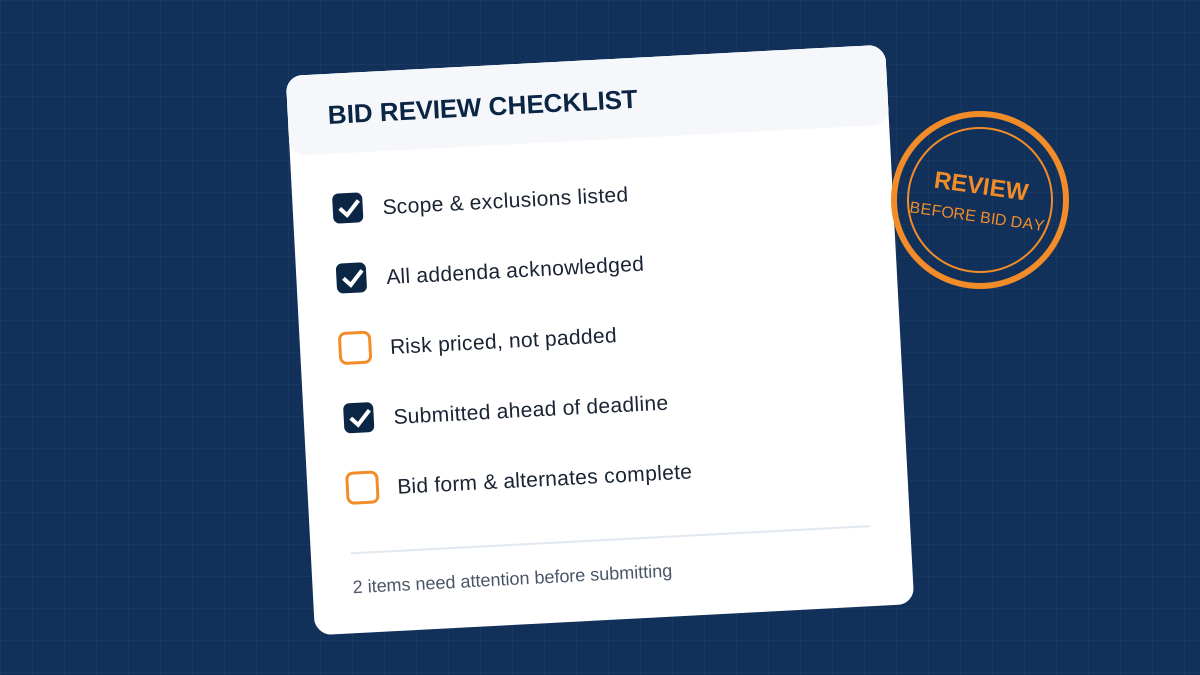
The common thread is simple: make your bid easy to understand and easy to compare. Clear scope, every addendum acknowledged, risk priced where it lives, time to spare and a complete bid form all signal a subcontractor who will be easy to work with.
If quantities are what slow you down, our quantity takeoff service delivers trade takeoffs you can price the same day.
Bidnora Engineering Team
Estimators & detailers
Articles written and reviewed by the estimators and detailers at Bidnora Engineering in Las Vegas, Nevada.